Transition Finance Weekly - March 26, 2026
Utility Intervenors for the People; Accelerating Geothermal; Hochul’s Self-Imposed Climate Backtrack
1. Michigan AG Steps Into DTE Gas Rate Hike
Attorney General Dana Nessel is trying to cut DTE’s proposed gas rate hike by 85%.
Michigan Attorney General Dana Nessel said last week that she filed against DTE Energy’s request to increase its rates for all customers by 10%. Under DTE’s proposal, residential customers would see at least an 8% increase.
Nessel criticized DTE in February when it announced that it would seek yet another rate hike, just days after the Michigan Public Service Commission approved a $242 million rate hike for its electric service.
Nessel isn’t alone here, either. Attorneys General are increasingly stepping into utility rate cases to defend their constituents’ pocketbooks as energy prices become more salient to customers. In Arizona, AG Kris Mayes has stepped in to block Tucson Electric Power’s proposed 14% rate increase, and North Carolina AG Jeff Jackson has stepped in to block multiple utility-proposed hikes.
Michigan Attorney General Dana Nessel, on DTE Energy’s proposed rate hikes: “It’s astonishing that our current system allows DTE to announce their next rate hike case less than one week after locking in a $242 million rate hike, all while the utility projects record profits.”

2. Massachusetts Sets New Energy Targets
Governor Maura Healey signs executive order setting new in-state clean energy deployment targets.
Last week, Massachusetts Governor Maura Healey signed an executive order ordering the state to bring 10 GW of new clean energy resources online by the end of 2035. The EO calls for 4 GW of new solar, and 3.5 GW of demand management capacity. Importantly, the EO also targets 5 GW of energy storage by 2035.
Healey’s EO includes recommendations to support the development of new resources, including improving interconnection processes, supporting the expansion of wind generation, and expanding distributed resources including microgrids.
Massachusetts Governor Maura Healey said, “While the President is taking American-built energy sources off the table, in Massachusetts, we are saying yes to more supply from more sources of energy. We are saying yes to American jobs and American energy independence. And we are saying yes to lowering energy bills for all.”
3. DOE Coal Orders Undermine Utility Planning, Face Resistance
Utilities are working to resist the Trump Administration’s emergency coal power plant orders as they undermine system planning.
Since taking office, the Trump Administration has forced 16 power plants nationwide to stay open, regardless of their cost to operators, in a bid to increase coal consumption in the United States. The plants forced to stay open include Tri-State G&T Cooperative’s Craig Station in Colorado, Constellation’s Eddystone in Pennsylvania, Campbell Power Plant in Michigan, and Washington State’s Centralia plant.
For state utility regulators, policymakers, and grid operators, the federal government’s politically-motivated efforts to boost coal are undermining their ability to plan for the future. The orders undermine state-level agreements, utility decisions, and laws binding utilities to decommissioning assets that they’ve concluded are too costly or inefficient to run.
For utilities, the orders are unnecessarily driving up their costs and similarly affecting their long-term planning. Consumers Energy says that the order keeping Campbell open has cost ratepayers $135 million in just a few months. Meanwhile, Tri-State and Platte River Power Authority filed to block the order.
Pete Wychoff, Deputy Commissioner of Energy Resources for the Minnesota Department of Commerce, on the order keeping Campbell open in Michigan: “This is nuts … we are not happy and are repeating to anyone who asks that there is a coal plant in Michigan that is being forced to stay open.”
4. Geothermal Can Connect Faster Than We Knew
Enhanced geothermal systems (EGS) can achieve commercial operation within three to six years of project initiation — a timeline that aligns with near-term resource planning.
A new white paper from the Center for Public Enterprise finds that novel enhanced geothermal systems (EGS) are ready for quicker deployment than previously thought. Unlike traditional geothermal systems, EGS uses horizontal drilling and hydraulic fracturing technologies, borrowed from oil and gas extraction, to use the Earth’s heat to generate electricity.
The paper argues that new EGS projects can start producing power within three years of breaking ground on construction, timelines which look incredibly attractive compared to other sources of clean firm energy like nuclear and traditional geothermal.
Even more key, EGS has extreme potential in displacing dirty generation, particularly due to its high capacity factor (over 80%) and its continued eligibility for a 30% investment tax credit. Coupled with the attractive timelines, the paper argues that western utilities should rush to include EGS in their next round of integrated resource planning processes.
5. Hochul Says She Can’t Meet Deadlines Of Law She Failed To Implement
New York Governor Kathy Hochul has delayed the implementation of the state’s landmark climate law, and now wants legislation to revise the goalposts.
Governor Kathy Hochul wrote an op-ed calling for legislation to delay the implementation of New York’s 2019 Climate Leadership and Community Protection Act, a landmark bill committing the state to 100% net-zero electricity by 2040. The law also binds New York to 40% GHG reduction by 2030 and 85% by 2050.
Hochul is now arguing that the law is at odds with “affordability” and says that the state won’t be able to meet the targets. Hochul also claims that the Trump Administration’s war on renewables is undermining the buildout.
But Hochul also failed to implement the law herself. Hochul’s administration failed to promulgate the rules and regulations required to achieve the cuts by 2024 as required by the bill. Hochul’s proposed rules would allow energy providers and homes to burn more dirty fuels for longer, exactly at the moment that those energy sources are skyrocketing in price.

SPOTLIGHT: Renewables Growing As Share of America’s Grid
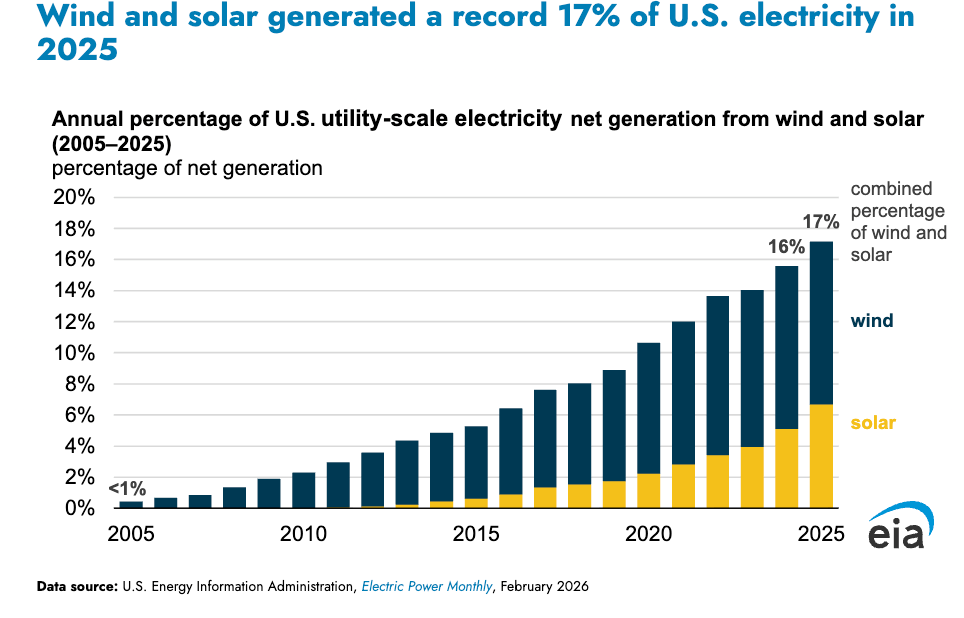
Wind and solar grew to produce 17% of all U.S. electricity in 2025, up from less than 1% in 2005 according to the Energy Information Administration. Even amidst a “war” on renewables from the Trump Administration, renewables continue to drive growth in the electricity sector. In 2025, 93% of the 63 GW of grid additions were wind, solar, or storage.