

Transition Finance Weekly - June 18, 2026
Soccer and Solar; Insurance Concerns; Oil’s Firearm Industry Moment

BREAKING:
New state-specific polling from the Insurance Fairness Project and Climate Power shows the growing salience of climate-driven insurance costs for Americans. The poll found that more than three-quarters of voters are concerned about the costs of insurance — and a staggering 26-30% have put off a significant purchase as a result of rising insurance costs.

1. California Solar Outperforms Gas in 2026
In May, solar topped coal nationwide for the first time. In California, solar is fast displacing natural gas.
In the first few months of 2026, solar surpassed California’s gas generation as percent of electricity production for the first time ever, increasing 21% over the same time period in 2024. Battery storage is helping solar beat out gas, as it allows excess solar energy from the day to be carried to times with little solar generation.
Also from January to May 2026, gas generation in the state fell from its 2024 levels by 60% — thanks to extensive solar and battery additions on the grid, and more imports from out-of-state hydro and wind energy.
Year-by-year, new clean additions to the grid continue to drive down the share of fossil fuels present on the grid while maintaining system reliability, in spite of the federal government’s best efforts to oppose new renewable energy.
2. Louisiana Protects Oil Industry from Lawsuits
As solar proves its inevitability in California, Louisiana moves to protect legacy fuels from liability from the damage their products have caused.
In Louisiana courts, Americans, companies, and municipalities now won’t be allowed to sue the oil and gas industry for its role in climate change as a result of the Louisiana Energy Protection Act. This legislation, signed into law by Louisiana Governor Jeff Landry this week, prohibits lawsuits against the industry for climate damages. Landry is a longtime climate denier and has worked to use the power of his office to support the fossil fuel and petrochemical industry.
Congress is considering similar legislation that would give the fossil fuel industry essentially blanket immunity for their emissions and role in causing — and covering up — climate change. The bills are a direct response to both a growing number of lawsuits against the oil and gas industry for climate-driven damages, and the growing number of alternatives to fossil fuels fueling the economy.
The liability shield has long been a target of the fossil fuel industry, which has aggressively lobbied and litigated for extensive liability protections that have been afforded to almost no other industry, except for the firearm industry.
3. Alaska Steps Closer To Public Subsidies For $54 Billion Project
As its price estimates continue to climb, the Glenfarne Pipeline might get a specially-made 90% property tax break thanks to Alaska’s Governor and State House.
By a 34-5 margin, the Alaska House voted last week to pass a bill trying to change the financial realities facing the Alaska LNG project, which is estimated to cost between $44 and $54 billion. The proposed pipeline will connect North Slope natural gas to new LNG export terminals near Anchorage, Alaska for export to Asia.
The 807-mile pipeline and Alaska LNG project has been in the works for a decade, but continues to delay its “final investment decision” pending more purchase agreements from foreign customers. This is despite existing multi-billion-dollar guarantees from Japan and federal support.
Still, generous conditions haven’t been enough for the Alaska LNG project: Governor Mike Dunleavy called a special session of the legislature to seek a massive property tax cut to subsidize the project, equating to a 90% reduction in property taxes.
Kay Brown, Arctic Policy Director at Pacific Environment, said,
Sponsors for the proposed 807-mile Alaska gas pipeline and liquefied natural gas processing and export facilities are seeking additional massive public subsidies to make the project viable. Even fallout from the largest “oil disruption in history” isn’t enough to overcome the need.
4. Trump’s Coal Plants To Be Built By MAGA Activists
The Trump Energy Department will give $18 million to a company led by a far-right activist with no energy sector expertise.
As part of Trump’s new $850 million push to subsidize coal plants, his administration plans to give $18 million to TerraSpark, a company proposing to build a 1.6 GW coal power plant in West Virginia, which would be the first new coal plant since 2013.
TerraSpark is led by Alex Phillips, who has no energy industry experience and instead has led a telecom company and an “America First” PAC. Phillips also hosted the far-right, Q-Anon-linked American Priority Conference (AMPfest).
The administration will be supporting TerraSpark by giving it taxpayer money to fund a feasibility and design study, which it apparently did without giving a heads up to the Republican lawmaker whose district would host the potential plant.
Mike McKenna, a former Trump energy official and current energy lobbyist: “This is not normal.”
5. Suspending the Federal Gas Tax Won’t Solve War-Driven Inflation
New research finds that suspending the federal gas tax won’t offset commodity price increases driven by the Trump-Iran War.
According to new research from the Yale Budget Lab, proposals to suspend the federal gas tax to fix war-driven inflation won’t make much of a dent in the overall fuel cost increases. The research finds that the average household will save $37 over three months against a $250 price increase.
The research should put to bed renewed calls from certain Democratic candidates for suspending the gas tax. Senate candidate James Talarico in Texas called for a suspension, while Graham Platner in Maine called for an end to the gas tax entirely. Democratic Senators have similarly proposed gas tax holidays.
At this point, however, suspending or ending the gas tax won’t fix much: a good deal of the savings will be retained by producers, while the government loses a critical revenue raiser that maintains the country’s extensive transportation infrastructure.

Spotlight: The World Cup Comes To The U.S.
This year’s 2026 World Cup is home in the United States, much to the delight of some of us here at Pleiades. This year’s World Cup is different, though: the tournament is being hosted across a massive geographic footprint spanning three nations, 22 million miles, and 2,800 miles between co-host cities Vancouver and Miami. The tournament is also in its first expanded format, increasing the number of teams from 32 to 48, and the number of games from 64 to 104, which also increases the total amount of travel for teams and fans attending the tournament.
The large geographic spread means that the tournament’s travel-induced carbon emissions will be higher than ever. And though existing infrastructure means lower construction-caused emissions, these gains aren’t enough to offset the gargantuan rise in transportation emissions, which represent a growing share of U.S. emissions. The tournament is set to double its emissions from its 2022 emissions, at 3.6 million metric tons of CO2, to 7.8 million metric tons this year.
The climate impacts aren’t off the field either: players, staff, and fans will be braving extreme heat at a number of games. The matches will be held with much of the North American continent facing above-normal temperatures.
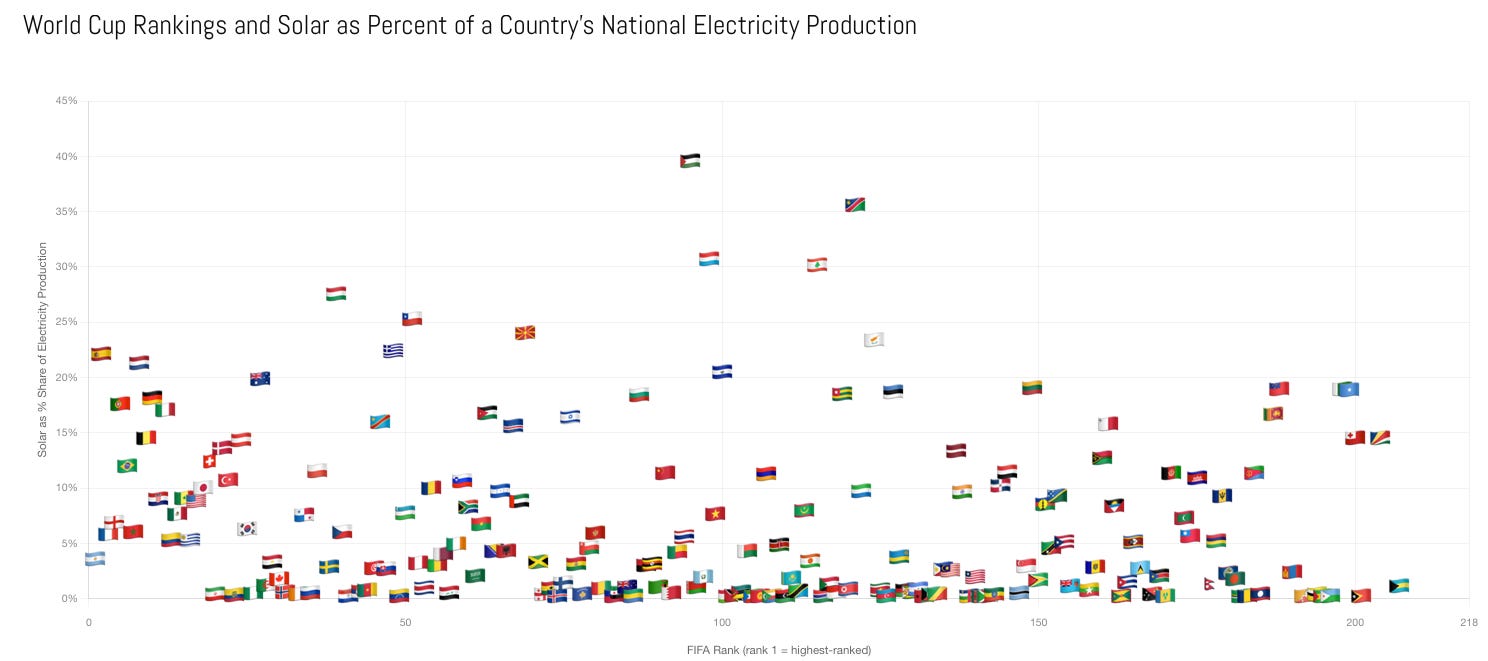
More fun: we thought it was also a great opportunity to highlight the big gains solar is making across the world. See our analysis of solar production and FIFA ratings — and let us know who you’re rooting for!

Go Yanks!