

Transition Finance Weekly - June 11, 2026
Solar tops coal nationwide; data centers’ changing politics; CA transmission FTW

BREAKING
According to a new report from Ember, solar topped coal as a percentage of US energy mix this May — marking the first time the technology has overtaken coal for a whole month and a sign of solar’s powerhouse role in the modern energy mix.
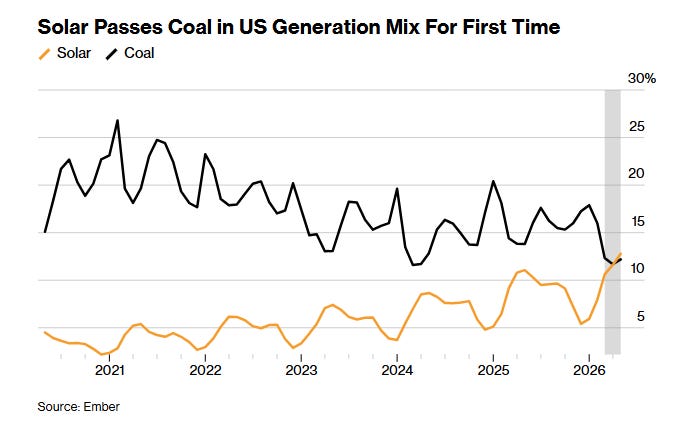
Source: Ember Energy via Bloomberg News

1. Data Centers Draw Criticism From Cheerleaders
As costs escalate and public opposition mounts, policymakers who boosted data centers are now turning on them — at least rhetorically.
As data centers are becoming more and more unpopular nationally, state policymakers are seeing increasing pressure to oppose them, or at least impose certain guardrails on the data center construction boom. This past week saw a flurry of activity across the states.
In Tennessee, lawmakers passed HB1847, a bill that requires data centers above 50MW in size to pay for the costs of grid upgrades. In Portland, in response to legislation passed last year, Portland General Electric announced that it would raise the rates data centers pay by 29%. Finally, in Ohio, lawmakers are reportedly planning a legislative package to “rein” in data centers following years of tax breaks to attract them.
Governors, too, are feeling the pressure. Utah Governor Spencer Cox ordered a “higher bar” for data centers, despite massively boosting data centers just months prior. Pennsylvania Governor Josh Shapiro, another former data center booster, established stricter standards for data centers being built in the state. The reaction from elected officials is an indication of the shifting politics: even data centers’ strongest cheerleaders are turning against them, as support increasingly looks like a political vulnerability.
2. Trump Administration Spends Even More To Subsidize Aging Coal
The administration wants to spend $850 million to subsidize aging coal power plants — and build two more.
Last week, the Department of Energy announced that it would commit $850 million to modernize more than a dozen coal facilities, boost coal export capacity, and build the first two new coal power plants since 2013.
The move isn’t out of step for the coal-obsessed Trump Administration: in addition to sabotaging renewable deployment, the administration has required multiple aging coal plants to stay open, at a very high cost to utility ratepayers. Now, the administration wants to deploy public dollars to do the same.
Contrary to the arguments of coal’s biggest supporters, there’s little reason to keep coal on the grid. It’s neither truly dispatchable nor flexible as an energy source, and is struggling to keep up reliability, especially during peak demand and extreme weather events. Coal is becoming increasingly expensive, following an opposite cost curve to renewable sources like wind, solar, geothermal, and battery storage, which are seeing significant price reductions every year. Of course, coal is also the dirtiest of fossil fuels, with significant impacts to local air pollution and emissions.
3. New York Wraps Up Legislative Session With Climate Rollback
New York’s legislative session closed last week with lower climate ambition, and no action on multiple bills targeting the insurance industry’s relationship with fossil fuels.
On Thursday last week, New York’s 2026 legislative session wrapped up, with a lot left to be desired from climate hawks. Hochul signed significant revisions to the state’s 2019 Climate Leadership and Community Protection Act (CLCPA), which had set ambitious targets for rapid decarbonization.
Hochul’s changes to the law include extending the deadline to design emissions reduction regulations until the end of 2028, eliminating a 2030 interim target of 40% GHG emissions reduction, and changing the state’s emissions accounting protocols. Hochul previously tried to justify the amendments by arguing that the law was too ambitious, despite failing to implement key regulations required under the law herself.
The legislature also closed without passing the Climate Accountability and Loss Recovery Act, which would allow the Attorney General to sue fossil fuel companies for climate-related damages, and the Insure Our Communities Act, which would require insurance companies to align their long-term strategies with climate targets.
4. Colorado Implements Property Risk Mitigation Law
Colorado Governor Jared Polis signs a bill to fund property-level fortification, as insurance costs continue to rise in the state.
Colorado Governor Jared Polis signed SB 155 into law on Monday. The bill creates a new state enterprise to fund property-level mitigation to reduce replacement costs driven by hail and other hazards and requires insurers to pay a 0.5% fee on premiums to fund the enterprise.
The state enterprise, the Strengthen Colorado Homes Enterprise, is one of many being designed and implemented by state policymakers as climate-driven hazards continue to drive risk across the country. Louisiana recently allocated $50 million in additional funds for its Fortify Louisiana Homes Program.
While these measures account for a small share of state budgets, they’re important for their role in reducing overall physical risk and driving a commensurate reduction in insured losses from climate-driven hazards.
Colorado Insurance Commissioner Michael Conway said, “SB26-155 builds on what we’ve done so far and will generate real savings for Coloradans through a hail mitigation grant program. Hail is the number one cost driver of homeowners insurance premiums in our state, and this legislation will ensure that more Coloradans can afford to upgrade their roofs, thereby reducing claims and risk across the state.”

SPOTLIGHT: Solving Challenges with Transmission
The California Independent System Operator (ISO) recently approved its new 2025-2026 transmission plan, with 38 recommended infrastructure projects to accommodate growing demand and more renewable energy resources on the grid. The plan calls for utilities to spend around $6.7 billion over the next 10 years.
The new transmission plan will allow the state to more easily develop energy resources, including 45 GW of solar generation in southern California and southern Nevada, 8 GW of in-state wind generation, and 2 GW of future geothermal generation in California and Nevada. The transmission upgrades will help California benefit from greater out-of-state resources across the West.
Transmission is hugely important to the energy transition: smart planning can reduce capacity needs by linking multiple markets together, and jumpstart energy development. In Texas, via Competitive Renewable Energy Zones, the state jumpstarted wind and solar development by building transmission before energy resources, thereby making energy development cheaper and faster. In that case, the benefits from the CREZ program far outpaced the costs.
