

Transition Finance Weekly - August 13, 2026
Amazon Building Mega-Polluting Plant, New CAISO Market Signatories, Climate Risks Come for All

1. Amazon Plans the Most Polluting US Power Plant
Tech giant Amazon wants to build an on-site power plant that would become the most polluting in the country.
As part of its Pecos County, Texas data center campus, tech giant Amazon said it will power it with “new on-site generation.” It wants to install 35 gas-powered turbines to generate up to 7.65 GW of electricity on-site, and it would be permitted to release as much as 33 million tons of CO2 per year.
Instantly, this facility would become the most polluting power plant in the United States. In 2025, according to EPA data, the most polluting power plant in the country was Alabama Power’s James H Miller Jr. Electric Generating Plant, a coal power plant that produced 21 million tons of CO2. The 33 million tons of CO2 is roughly equivalent to 9% of California’s total emissions, and more than the state’s agricultural emissions.
While the company insists its commitment to emissions reduction “hasn’t changed,” it’s entirely unclear how Amazon can both construct this facility and meet its goal to eliminate its emissions by 2040. These forms of irresponsible power arrangements are also driving opposition to data centers.

2. Montana Utility Joins CAISO’s Energy Market
BHE Montana agreed to join the California grid’s new extended day-ahead market.
On Monday, utility BHE Montana announced that it would join California Independent System Operator’s (CAISO) extended day-ahead market (EDAM). The EDAM allows power producers and buyers to buy and sell electricity the day before delivery, allowing grid operators to coordinate supply and demand ahead of time.
BHE is now the eighth participant to join the market, linking CAISO’s market to Montana on top of utilities in California, Oregon, Nevada, Utah, New Mexico, Idaho, and Washington. Broader regional coordination and electricity markets can both significantly lower emissions and costs by improving efficiency across greater areas.
By linking different states, power production in different regions, especially renewables like wind and solar, can supplement each other. CAISO’s modeling shows that the wider EDAM could reduce CO2 emissions by 1.5% across the utility service territory and save Western states $1.2 billion annually.
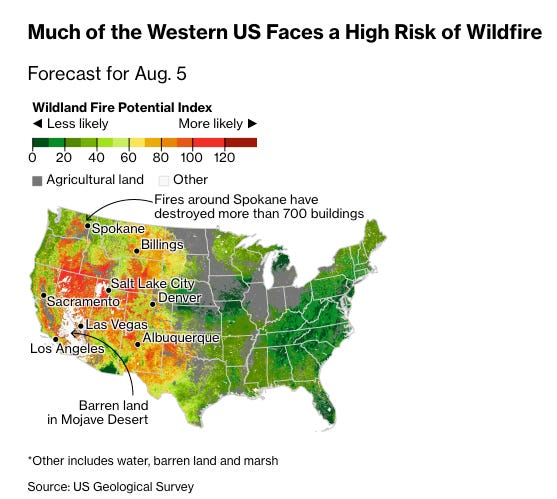
3. One of the Worst Fire Seasons in Years
The Western US becomes the latest fire record-breaker as high temperatures create conditions for fire.
After wildfires threatened major European cities in France and Spain, the United States is experiencing one of its worst wildfire seasons in years. For months, fire and climate experts have warned of “elevated” wildfire risk through the year.
The entire Northern Hemisphere this year has experienced a record-breaking wildfire season that has burned millions of acres and caused hundreds of thousands of people to evacuate, and burned thousands of structures.
Following an exceptionally hot July, more than 600 fires started in Oregon and Washington, forcing thousands from their homes. In Spokane, Washington, around 10% of the city’s residents have been forced to evacuate their homes. Simply put, climate change and rising temperatures are elevating the risk and conditions for wildfires.
4. Data Centers Face Climate Shocks
Research finds that an overwhelming majority of global data center capacity face “elevated” climate risk.
A study from climate data group First Street found that the tech industry’s “largest and fastest-growing hubs” for data center development are concentrated in climate-vulnerable areas, with worsening climate risks. 79% of global capacity faces “acute climate hazards” like flooding, hurricanes, and wildfires while 54% of capacity faces “chronic climate stress” like extreme heat or drought.
These figures directly threaten data centers’ bottomline: major climate-driven disasters directly threaten their coveted “5 9s” of uptime, which requires data centers to be available for 99.999% of the year and unavailable for only 5 minutes and 15 seconds annually. Also importantly, chronic heat and drought, worsened by climate change, significantly increase data centers’ cooling needs, thereby massively increasing their power consumption and costs.
The elevated operational risks to data centers is also becoming a challenge for insurers: provider Allianz Commercial warned this week that the complexity, value of input materials, and elevated climate risks faced by data centers make them complicated to insure. Allianz claimed that “climate-aware site selection” is critical to accessing insurance.
5. Fossil Fuel Advocates Want A ‘Constitutional Right’ To … Natural Gas
In Colorado, fossil fuel-backed advocates are pushing for a constitutional amendment to enshrine a right to natural gas.
This week, Advance Colorado submitted petition signatures to the state Secretary of State’s office to get Initiative 177 on the November ballot. The ballot measure says that consumers “have the right to purchase natural gas,” and that utilities equally have “the right to sell natural gas.” Meanwhile, active fires have burned thousands of acres and hundreds of homes across the state.
Advance Colorado doesn’t disclose its donors, but an investigation found that the group was funded in part by “pass-through” donations from Phil Anschutz, an oil magnate who served on the board of the American Petroleum Institute.
The language of the initiative is overly broad, and it’s unclear if it would impact Colorado’s new 2025 statewide building code which encourages, but does not require, all-electric building. The language, too, wouldn’t necessarily compel individuals, homeowners, or builders to install gas hookups, either.
As fewer people use fossil fuel infrastructure, like the natural gas distribution system, the economics of those systems become more challenging for producers and customers, who have to pay a significantly higher per-customer cost to maintain shrinking infrastructure. This initiative would just exacerbate this problem and take away the state’s ability to manage the transition.
Conservation Colorado CEO Kelly Nordini said, “Nothing like it exists anywhere in the country, and for good reason: our Constitution is meant to protect fundamental rights, not guarantee one industry’s profits.”