

Transition Finance Weekly - April 17, 2026
Data Center Costs; Clean Energy Wins in Arizona; Oil and Gas Liability Shield


Meet Pleiades at SF Climate Week
We spend a lot of time thinking about how climate conversations get siloed. Energy people talk to energy people. Transportation advocates talk to transportation advocates. Insurance wonks talk to insurance wonks.
But the threads connect.
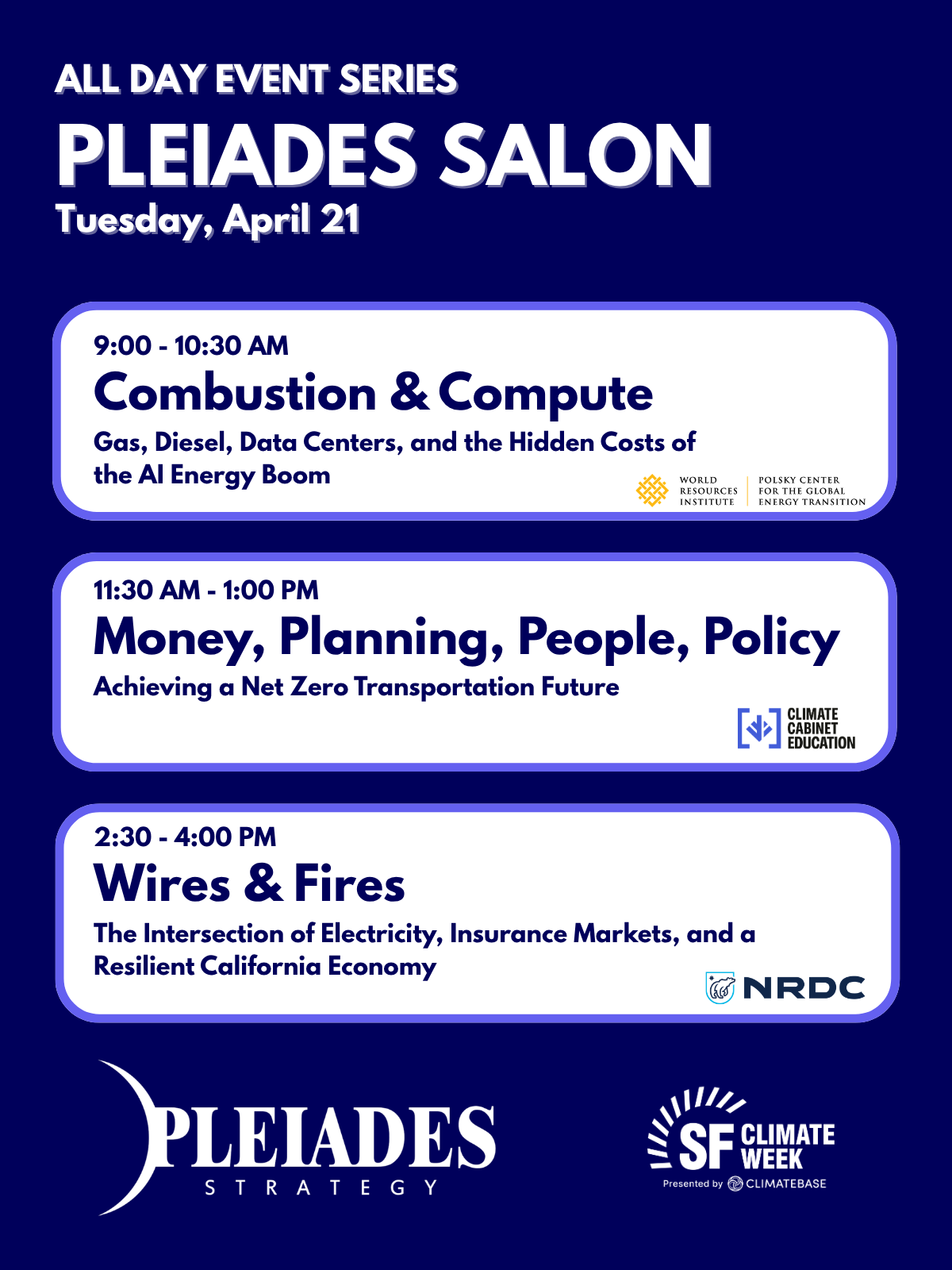
On April 21, Pleiades Strategy is hosting a full day of conversations at SF Climate Week with some of our favorite thinkers and doers digging into topics that deeply matter — the Pleiades Salon. Three conversations, one through-line: the places where climate risk, the energy transition, economic opportunity, and policy collide in ways that demand our collective attention.
We hope you’ll join us.
Tuesday, April 21 | San Francisco

1. Data Centers Draw From State Budgets As Wallet Impacts Get Sharper
Data centers are costing governments larger and larger amounts of money, as energy done wrong costs ratepayers too.
The Texas Comptroller’s office found that the state will lose out on $3.2 billion in state sales tax revenue as a result of the state’s tax exemption for certain data center project developers. Texas isn’t the only one, either: Virginia’s tax breaks for data centers cost the state $1.6 billion in missed revenue last year.
As a result, more states are considering paring back or entirely eliminating state incentives for data centers, partially because the incentives themselves are secondary considerations for data center developers who are prioritizing fundamentals like land and energy.
Meanwhile, the structure of energy deals themselves are just as important: without the right safeguards, state policies, and utility approaches, data centers can be incredibly costly for existing ratepayers. It’s on policymakers to reclaim their authority to exercise the appropriate oversight and supervision of continued data center development, without harming state budgets and ratepayer wallets.

2. Clean Energy Slate Wins in Arizona
Clean energy-supportive candidates won a majority on the Salt River Project utility’s board.
Last week, a slate of candidates broadly supportive of renewables and clean energy won a majority of the seats on the Salt River Project’s board. SRP is Arizona’s largest public utility, and delivers power to more than 2 million customers.
The races drew attention, in part because of the SRP’s unusual system of awarding one vote per acre to landowners in its service territory, and also because the far-right advocacy group Turning Point USA endorsed its own slate of candidates.
Though two TPUSA-backed candidates won seats on the board, the Clean Energy Team swept the remaining races and won an outright majority on the board. SRP’s board will be majority pro-renewables for the first time in its history.
Ken Clark, one of the new Clean Energy Team board members, said,
“Starting when we’re sworn in, S.R.P. will be the largest utility in the country with a majority vote of clean energy supporters. There has been a pent-up demand, especially in Arizona, for people to have their energy freedom, to have solar panels, batteries and more energy-efficient measures.”
3. Climate Costs Are Already Costing Households $900 Per Year
The costs of climate change aren’t a far off abstraction: they’re here, and getting bigger.
According to research from a trio of economists, climate change is costing the average American household around $900 per year, a figure with significant geographic variance. For 10% of counties, the cost is significantly higher at $1,300 per year per household.
Insurance costs alone, driven upward by the increasing frequency and severity of climate-driven disasters like hurricanes and wildfires, account for a majority of the direct costs to households. Higher insurance costs are contributing to a $600 increase in household expenditures, up to $1,000 in the highest-cost areas.
In total, the aggregation of these costs amounts to $110 billion per year in the United States, a figure that will continue to grow absent additional climate action.
4. Oklahoma’s Highest Court Rules Anti-ESG Law Unconstitutional
After years of litigation, the Oklahoma’s Energy Discrimination Elimination Act is dead.
The Oklahoma Supreme Court issued a permanent injunction against the state’s Energy Discrimination Elimination Act of 2022, upholding a 2024 lower court decision ruling the law as unconstitutional. Oklahoma’s EDEA was one of the first anti-ESG laws passed nationwide, and required the state to blacklist companies that allegedly “boycott” fossil fuel companies.
Though the law was blocked on constitutional grounds as a result of a retiree-initiated lawsuit, it also significantly increased costs to taxpayers, who were forced to pay $180 million in additional borrowing costs because of restrictions put in place via the EDEA.
Oklahoma’s law isn’t the only anti-ESG law blocked either: a federal court struck down a similar law in Texas, which required the Comptroller to develop a “business blacklist.” And in Missouri, an anti-ESG rule proposed by the Secretary of State, which would have required investment advisors to make politically-charged statements, was struck down by a federal judge.
5. Coal Plants Aren’t Operating, Despite DOE Orders
“Emergency” orders by the Trump Administration don’t make the coal math work.
Three coal-fired power plants, which were ordered to stay open beyond their closure dates, are not operating. The Trump Department of Energy has used little-accessed federal emergency authorities to force coal power plants to stay open past planned closures, contradicting what utilities, grid operators, and states say they need.
Generators at the Washington State Centralia power plant, Craig in Colorado, and R.M. Schahfer in Indiana didn’t generate any electricity in January. Tri-State Generation & Transmission in Colorado, the owner of the Craig Power Station in Colorado, formally objected to the DOE’s order.
Meanwhile, as states, consumer advocates, and environmental groups sue the administration over its coal orders, the costs for utilities and ratepayers are mounting: the costs of keeping just one Michigan coal plant open have ballooned to over $135 million in less than one year. Even without generating power, Craig Station costs $80 million per year to keep operational.

Spotlight: Oil and Gas Industry Looks to Liability Shield
Fresh off its campaign to toxify corporate climate efforts, key anti-ESG leader Will Hild and donor Leonard Leo are organizing a new campaign to pass measures giving the oil and gas industry a liability shield against the damages their products have created. This replicates a playbook from the gun industry to avoid liability for the harms their products perpetuate. In 2026, Utah became the first state to pass measures to protect the oil and gas industry from litigation. The oil and gas industry is also fighting tooth-and-nail against measures in other states that would require the industry to pay for the costs caused by their extensive pollution.
Former California Insurance Commissioner Dave Jones characterized the efforts as “beyond dangerous.” Jones argues that making polluters pay is one of the most important avenues for funding climate change mitigation and recovery efforts, especially as the Trump Administration slashes federal disaster funding and climate-related programming.