



Pleiades at SF Climate Week
We spend a lot of time thinking about how climate conversations get siloed. Energy people talk to energy people. Transportation advocates talk to transportation advocates. Insurance wonks talk to insurance wonks.
But the threads connect.
On April 21, Pleiades Strategy is hosting a full day of conversations at SF Climate Week with some of our favorite thinkers and doers digging into topics that deeply matter — the Pleiades Salon. Three conversations, one through-line: the places where climate risk, the energy transition, infrastructure, and policy collide in ways that demand our collective attention.
We hope you’ll join us.
🗓 Tuesday, April 21 | San Francisco

1. California Earthquake Authority Releases Wildfire Study
As ordered by the state legislature and Gavin Newsom, the Wildfire Fund Administrator issued recommendations to overhaul California’s insurance and energy landscapes.
The California Earthquake Authority, which manages the Wildfire Fund, came out with its final recommendations after a multi-month examination of the state’s insurance market and electricity system, which included nearly 80 submissions from environmental, consumer, industry, business groups, and government agencies. The study was mandated by SB 254, a bill passed in the wake of the 2025 wildfires that added $18 billion to the wildfire fund.
The report falls short of endorsing a specific policy path forward, but issues a number of recommendations under three main categories, including how to manage physical risks, how to allocate risks and “burdens,” and what the state’s potential role could be in the market.
Though it gives plenty of options for lawmakers to consider, the report is unequivocal in its declaration that any real solution to the insurance crisis must come with real, serious physical risk reduction measures at the property and community level.
2. Pair of Pennsylvania Bills Will Enhance Existing Electricity Assets
Lawmakers in Pennsylvania are considering bills to deploy advanced transmission technologies and VPPs to enhance the grid.
As part of a growing trend across the country, lawmakers in Pennsylvania are considering two bills to increase the grid’s ability to take advantage of existing resources on the grid, HB 2223 and HB 2264. HB 2223 would require utilities to consider deploying advanced transmission technologies and HB 2264 would require utilities to develop virtual power plants.
Both solutions would make the grid significantly more efficient and allow grid operators and utilities to increase grid utilization. And virtual power plants in particular have emerged as a significant opportunity to coordinate and aggregate distributed resources to potentially add up to 60 GW of capacity to the grid by 2030.
The bills face significant headwinds, though: the legislature has been slow to take up bills, even those backed by Governor Shapiro. Strategies to take advantage of existing grid assets also don’t fix Pennsylvania’s relative lack of clean generation assets, which exists in part thanks to the state’s arcane rules which add $6,000 to the cost of residential solar systems.
House Energy Committee Chair Rep. Elizabeth Fielder said, “We know that we are dealing with serious supply chain problems and demand problems, and that we need to do everything we can to get as much as possible out of our existing infrastructure.”
3. Minnesota Approves Xcel’s “Distributed Capacity” Program
Minnesota regulators approved the state’s first virtual power plant, but distributed energy advocates criticize the utility-centric model.
Xcel Energy received approval from Minnesota regulators on its Capacity*Connect program, a utility-owned 200 MW distributed storage and VPP program. Xcel has permission to develop up to 200 MW of energy storage across its grid with 1 to 3 MW batteries.
The VPP program is unique: most VPP programs use customer-sited and customer-owned energy resources. Meanwhile, Xcel itself is operating a VPP program in its Colorado service territory.
Though Capacity*Connect leaves out customer-sited resources, it’s revealing from the company and an acknowledgement that a substantial piece of the future of the grid will be distributed, including those operated by major investor-owned-utilities.
4. Nevada’s Largest Utility To Join New California Market
Nevada’s PUC will allow NV Energy to join CAISO’s new electricity market in a game-changing move.
Last Friday, the Nevada Public Utilities Commission approved NV Energy’s request to join the California Independent System Operator’s new Extended Day-Ahead Market (EDAM). CAISO, which manages California’s electricity grid, is proposing a new energy market to share energy and grid resources across a wider geography, through EDAM.
EDAM is launching May 1, 2026 with PacifiCorp and Portland General Electric, with more grid operators and utilities slated to join in the next year. EDAM will also provide significant benefits for DER and VPP integration into a wider wholesale market.
The launch of a new Western energy market is a significant milestone for the grid. As with “smaller scale” energy system upgrades, linking regions with coordinated energy markets and transmission unlocks more capacity everywhere and reduces the need to build additional generation.
5. Trump Admin Takes Axe To Forest Service
As fire risk grows and the West approaches wildfire season, the Trump Administration is moving to close three quarters of its forest research facilities.
The Trump Administration is moving to massively reorganize the U.S. Forest Service, which manages 193 million acres of federal land and works on wildfire suppression and mitigation across the country. As part of the cuts, the administration is shuttering 57 of the agency’s 77 research stations and moving its headquarters to Salt Lake City, Utah from Washington, D.C.
The move is reminiscent of Trump’s reorganization of the Bureau of Land Management during his first term, in which he moved the agency’s headquarters to Colorado from Washington. His chief of staff at the time claimed that moving agency headquarters was a “wonderful way” to get federal employees to quit. Some anticipate that the Forest Service will lose as much as half of its workforce in the move.
The Forest Service could be unequipped for what is expected to be a more-dangerous-than-usual wildfire season across the Western United States, which is already dealing with a significantly warmer and drier winter than usual.
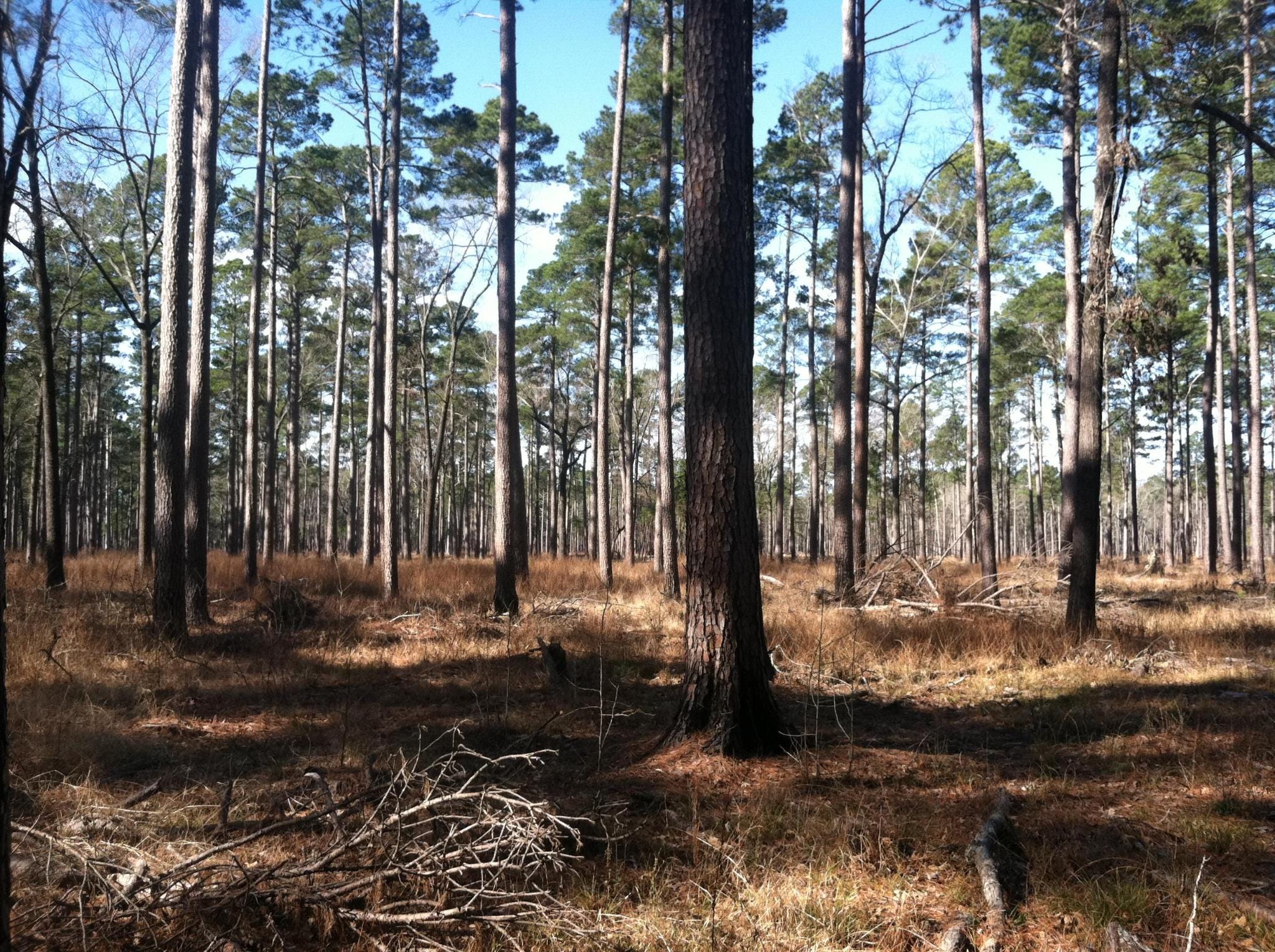
A prescribed burn site at the Crossett National Forest research station, one of the long-standing USFS research hubs that has added to our understanding of scientific forest management and resource management that is at risk from cuts to USFS science programs. Taken on a field trip by Frances in 2014.